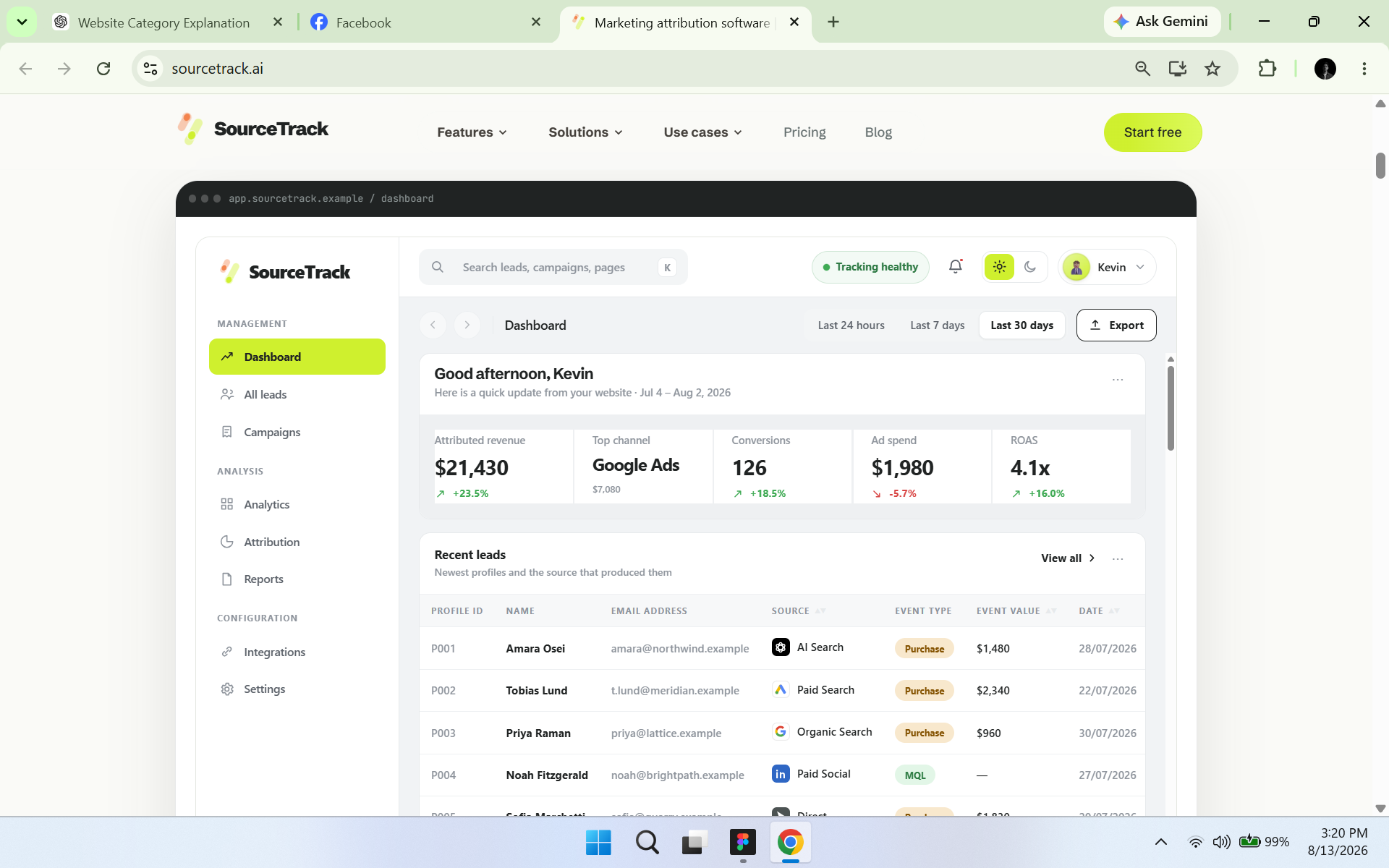
Transparent attribution
See which channels, campaigns, and AI platforms drive revenue so you know where to focus your marketing.
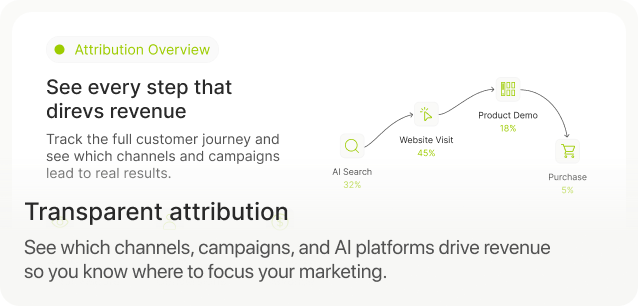
Track customers across ads, AI assistants, social channels, and your website and see exactly which touchpoints turn into revenue.
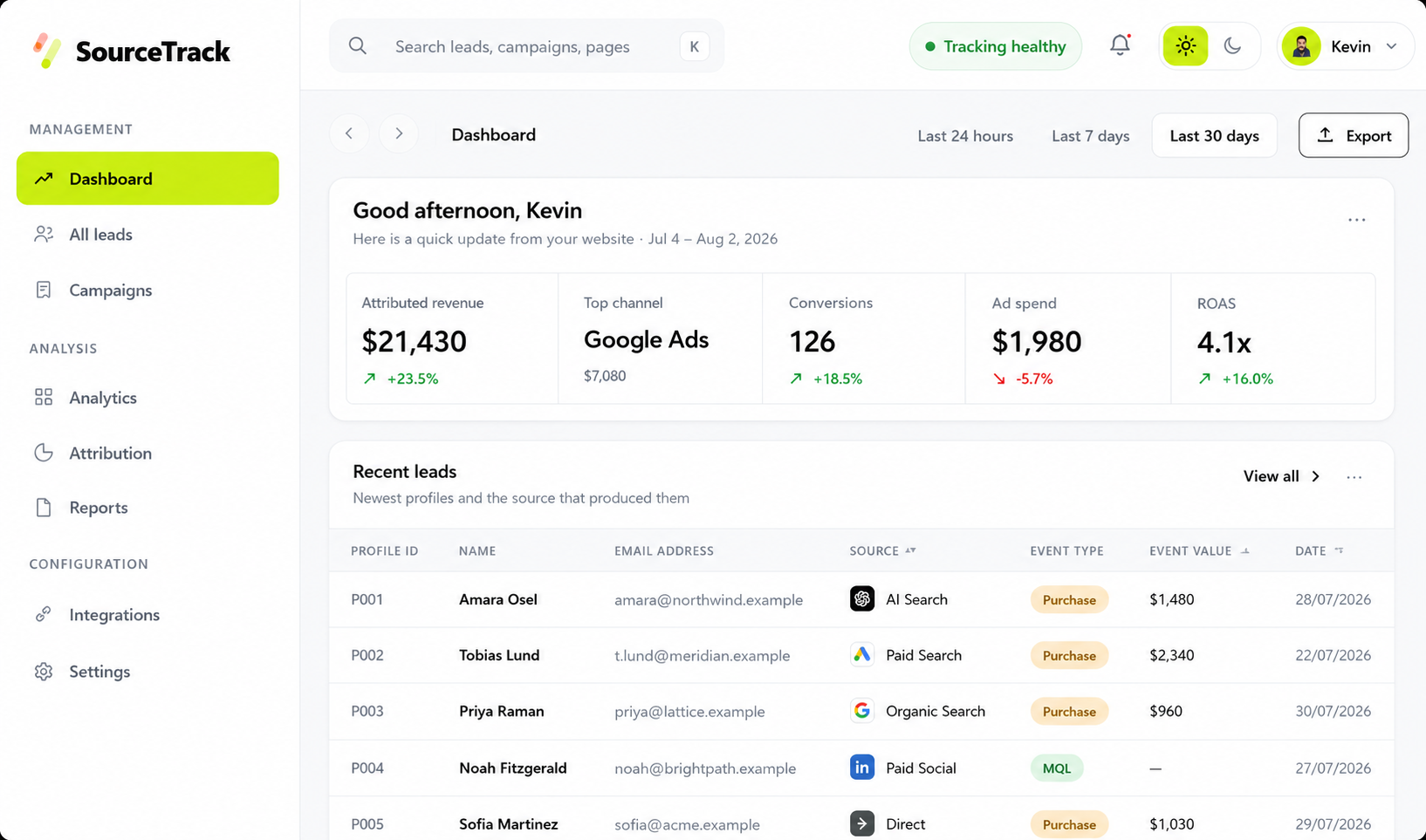
Know what works
Understand your customer journey and see what drives revenue.
See which channels, campaigns, and AI platforms drive revenue so you know where to focus your marketing.
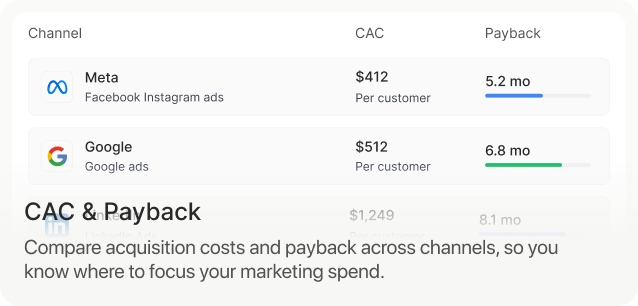
Compare acquisition costs and payback across channels, so you know where to focus your marketing spend.
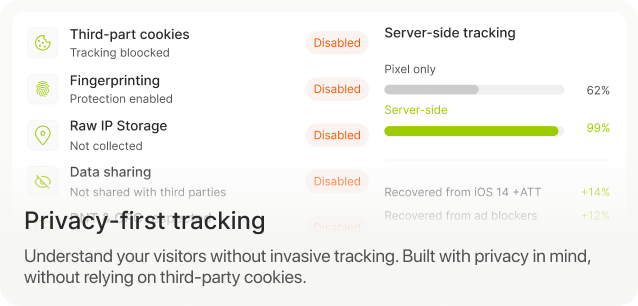
Understand your visitors without invasive tracking. Built with privacy in mind, without relying on third-party cookies.
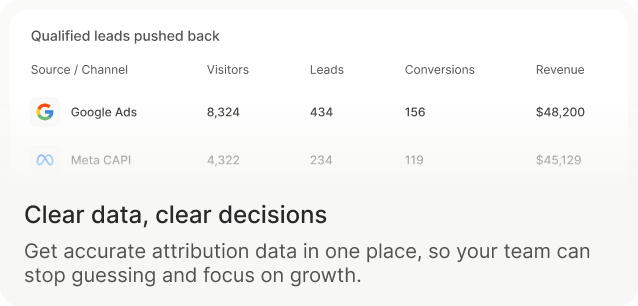
Get accurate attribution data in one place, so your team can stop guessing and focus on growth.
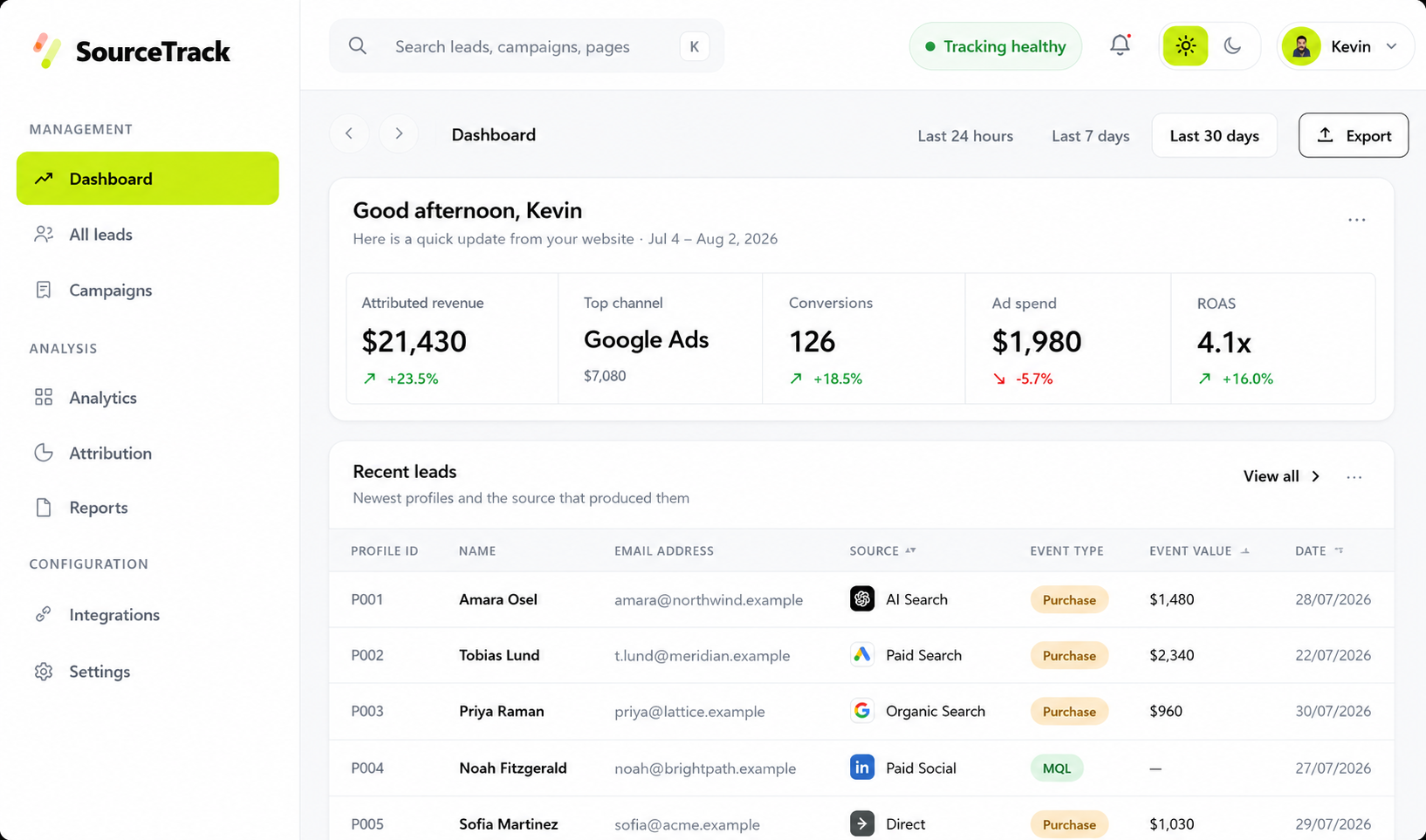
About Sourcetrack
SourceTrack helps marketing teams and agencies connect every customer journey to the channels, campaigns, and AI platforms that drive revenue.
Instead of relying on fragmented analytics or last-click attribution, SourceTrack brings your marketing data together in one clear view — so you can understand what's working, make smarter decisions, and grow with confidence.
Track smarter. Attribute accurately. Grow faster.
Accurate Attribution
Filter out AI referrals, bots, and noisy traffic to keep your attribution data clean, reliable, and ready to act on.

AI Referral Attribution
See where AI traffic comes from.
Identify visits from leading AI platforms and connect them to the campaigns and revenue they influence.

ChatGPT
32.6%

Claude
24.8%

Gemini
18.7%

Bot & Crawler Filtering
Keep noise out of your data.
Automatically detect bots, crawlers, and suspicious traffic before they distort your analytics funnels or conversion data.


Direct

Referral

Privacy-First Attribution
Track without invasive data collection.
Track customer journeys with privacy-first, first-party data. No cross-site tracking and no third-party cookies. Visitor identifiers are never shared between different companies’ websites.

First-party
tracking

Privacy
compliant

No cross-site
tracking
Customer Journey
See how customers move across AI search, paid ads, organic search, and direct visits — and understand which touchpoints contribute to the final conversion.

Amara Osei
Customeramara@northwind.example · Northwind

6
Touchpoints

5
Sources

$2,340
Revenue
Pending

Jul 15 · 08:41
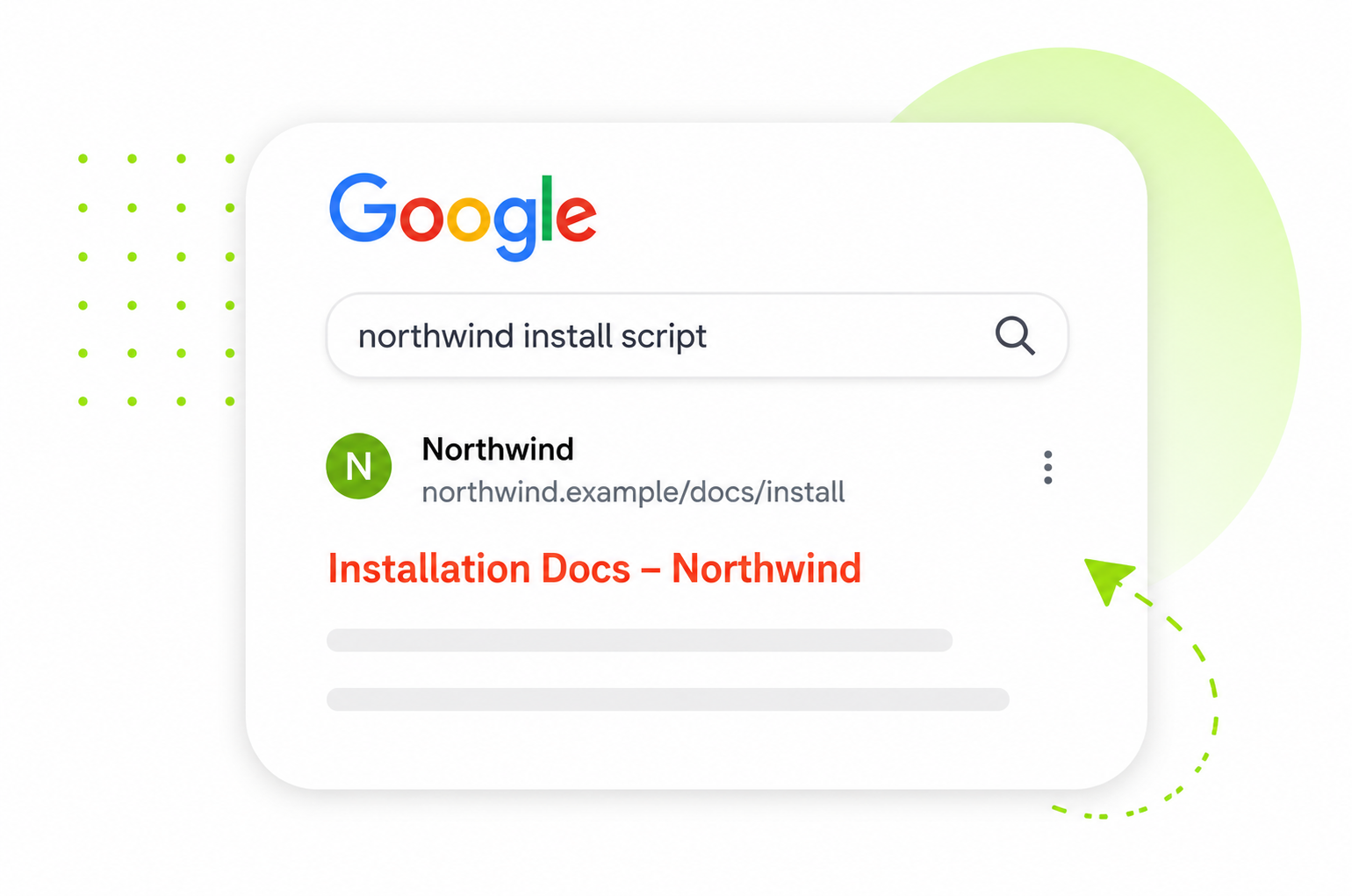
/docs/install

Search Query

Landing Page
GSC Match
Touchpoints
3 of 6
Sources so far
3

Ai Assistants
2
Revenue Attributed
$2,340

Pick a touch

15 Jul
Integrations
Connect your existing marketing stack and
track every conversion in one place.
Product Tour
Track visitors, revenue, AI referrals, and organic search in one clear
workspace built for smarter marketing decisions.

01 Real-time visitors
See what's happening on your site right now — monitor
active sessions, landing pages, and traffic sources

Wise Dolphin
/pricing

ChatGPT

Wise Dolphin
/compare/ga4

Google ads
Wise Dolphin
/features

Organic
Wise Dolphin
/demo

Wise Dolphin
/blog/utm-tracking

Perplexity
Wise Dolphin
/pricing

Direct

02Revenue attribution
Connect revenue back to the click that earned it.
even when it's re-credited under any of ten models
Channel
Visitors
Conv.
Revenue

Paid Search
1,568
32
$7,080

Organic Search
1,432
27
$5,420

Direct
2,541
28
$4,930

AI Search
650
20
$2,580

Paid Ads
596
10
$1,035

Referral
526
5
$480

10 attribution models

Real revenue tracking
02AI Bot Traffic Analytics
Discover when bots and AI assistants crawl your website.

ChatGPT
1,530

Claude
1,421

Gemini
829

Grok
423

02SEO revenue by keyword
See which organic keywords and landing pages drive the
most revenue not just traffic

Search Console

Stripe revenue

Webflow

WordPress

Organic traffic that converts
How It works
Connect SourceTrack once, capture every customer touchpoint and see exactly how your marketing contributes to revenue
01

1-line install
Track
Capture every customer touchpoint.
Add one lightweight script to your website and start tracking visits, referral sources, campaigns, and customer journeys.
Active
<script src="https://api.srctk.com/tracker.min.js"
        data-site-key="st_live_a48f92"
        async></script>
First-party tracking

12ms execution
02

Connect your stack
Connect
Connect the sources that drive revenue.
Connect your CRM, forms, payments and marketing platforms to bring conversion data into one attribution workflow.

Stripe
Connected

Shopify
Connected

HubSpot Forms
Connected

Real-time data sync

Zero lag
03

Multi-touch attribution
Attribute
See the complete path to revenue.
SourceTrack connects every touchpoint to the final conversion, showing which channels and interactions contributed to the sale.

ChatGPT
First touch

Google Ads
Mid touch

Google Ads
Mid touch

$2,340 Revenue
Converted

Revenue attribution

10 models
Use cases
Connect SourceTrack once, capture every customer touchpoint and see exactly how your marketing contributes to revenue

Full-funnel attribution
01
SaaS & B2B
Track trials, demos, and subscriptions across the full customer journey — not just the final click.


ChatGPT → Trial
→ Paid, in one row
Explore


Store-to-revenue
02
eCommerce & Shopify
From store to revenue, all in one view — track Shopify orders across ads, organic and referrals with refunds in sync.


Shopify order → campaign,
refunds netted
Explore

CRM source tracking
03
Lead Generation
Capture the original source behind every form submission, call, and booked meeting before it hits your CRM.


Source on every lead
before your CRM.
Explore

Multi-workspace
04
Agencies & Portfolios
Give each client a clear view of their marketing performance with separate workspaces and reporting.


One workspace
per client
Explore
Capture
Capture leads conversations bookings signups payments and store orders in one place so every conversion stays connected to the source that drove it.
 Forms01
Capture every form submission with the original source, campaign, and landing page attached.



 Chat02
Know where every conversation starts and carry its source through the entire customer journey.


 Meetings03
Attribute every booked demo or call to the campaigns and channels that drove them.



 Signups04
Track trials, registrations, and account creation from the first touch to successful signup.


 Payments05
Connect payments and recurring revenue to the channels and campaigns that generated them.
 Store Orders06
Connect ecommerce orders to campaigns visitors and key touchpoints that drive purchases.

16
AI assistants & search engines Revenue attributed, not just detected

9
Attribution models running on one first-party dataset.

1
Script tag to install No tag manager, no data engineer.

30+
Tools it captures from and syncs back to your stack.
Attribution models
Compare attribution models across the same customer journey and see which channels drive the most revenue without changing your underlying data.

$21,430
Total Attributed Revenue

126
Conversions

6
Active Channels
 6 ChannelsJul 4 – Aug 2, 2026
Pick a model below — visits and conversions never change, only the credit does.
$21,430
Recorded Revenue
Credit goes to the first recorded touch. Discovery channels look stronger.


Credit goes to the final touch before conversion — inflates Direct and branded returns.
First touch with Direct entries removed — discovery channels get full credit.
Last non-direct touch — returns and closes win; Direct is excluded.
Equal credit across every touchpoint — flattens channel differences.
40% first touch, 40% last touch, 20% shared — classic lead-gen weighting.
First, middle, and last touch each get 30% — highlights assist paths.
Closer touches get more credit — recent demand capture wins.
Only AI assistant referrals earn credit — isolates ChatGPT / Claude / Gemini traffic.

The GA4 Problem
Go beyond pageviews and sessions. See which channels and campaigns drive real revenue across every customer journey.

GA4 Default Report
VS

SourceTrack Revenue view

Users
12,540
394 verified conversions

Sessions
17,824
Every conversion carries its path

Engagement rate
48.3%
Source attached on arrival

Attributed Revenue
$120,340
394 verified conversions

Conversions
394
Every conversion carries its path

Leads
$1,208
Source attached on arrival

Bounce rate
51.7%
Landing Pages + GSC queries

Conversions
394
campaigns + keywords

Revenue
Not clearly tied to source

SEO Revenue
$31,050
Landing Pages + GSC queries

Google Ads Revenue
$48,200
campaigns + keywords

Revenue Journeys
Visitor > lead > customer
Top channels by traffic
Sessions


Revenue attribution needs more setup and analysis
GA4 tracks traffic and events, but tying revenue to channels takes more work.

Harder to follow the full customer journey
visitor-to-lead-to-customer visibility is less direct.
Top revenue sources
Revenue


Clear revenue sources attribution built for marketers
See which channels campaigns and keywords drive leads and revenue
Analytics + Attribution in one view
Connect traffic, leads, journeys, and revenue without extra report hunting.


Attribution engine
Give each client a clear view of their marketing performance with separate workspaces and reporting.


Paid, organic, social, AI and referral sources classified on arrival.
Close the loop
Send verified conversion and revenue data back to your ad platforms CRM and reporting toolsso every channel can optimize against what actually drives revenue.


Stop optimizing toward form fills Push qualified leads booked demos and closed-won amounts server-side so bidding learns from revenue.

Map once Every new contact lands with first touch last touch campaign click ID and the journey attached no rep guessing in a free-text field.
Select the channel and landing page data to include.
Cookie loss, ad blockers, and tracking prevention quietly delete conversions from browser-only pixels Server-side ingest and click-ID stitching keep them attached
I ran site health and event checks:


Illustrative conversation — not a live customer answer.
Separate workspaces per brand, switched from the sidebar No juggling accounts, no per-seat billing on the way up.
Illustrative figures — not live customer data.
Build the view once, save it, and let it land in your clients' inbox every week or month with the raw rows & CSV away when someone asks.
GoogleMetaIllustrative figures — not live customer data.
Optimize your spend
See where your ad spend is actually generating revenue and where blind spots are quietly wasting budget.

Track the full journey
Capture every touchpoint from first visit to closed-won revenue.

Connect revenue to campaigns
Bring revenue from Stripe, Shopify, and your CRM back to the channels that drove it.
See your true ROAS
Measure campaign performance using actual revenue, not just leads or clicks.
Reallocate with confidence
Shift budget toward revenue-generating campaigns and away from underperformers.





$10,000

20%

20% is an example, not a benchmark. To find yours, take a month's orders or deals from your store or CRM, subtract the conversions your ad platforms report for the same month, and divide by the orders. Blocked scripts, iOS restrictions and stripped UTMs are the usual causes.

What that means

Spend optimised on incomplete data
$2,000/mo

Over a year
$24,000/yr

Cost per conversion your platforms report, above the real one
+25%
How we calculate this
Spend optimised on incomplete data = monthly ad spend × share missed. Over a year = that × 12.
Your platforms see only (1 − share missed) of your conversions, so the cost per conversion they report is the real one ÷ (1 − share missed).
Arithmetic on your two inputs, not a forecast. It assumes the missed conversions are spread evenly across your spend.

See every client's revenue in one place
Clients link their site to your agency with an invite code either side can revoke. See each client's attribution read-only, and hand over branded PDF reports built from the same numbers as their share link.
Learn more about SourceTrack for agencies →
Client portfolio view

Branded PDF reports

Your logo and colours
One record of what converted, under any model
Compare ten attribution models on the same first-party data, classify untagged and AI-assistant traffic, and send confirmed conversions back to Meta, TikTok and LinkedIn server-side.
Learn more about SourceTrack for marketing teams →10 attribution models
AI referral tracking
Server-side conversions
Know which channels bring paying customers
One script tag plus a Stripe or Shopify connection ties revenue back to the visit and campaign that brought each customer, without a data team to build it.
One script tag
Stripe and Shopify revenue
Revenue by channel
Closed deals tied back to the first touch
Send CRM stage changes and closed deals to the offline conversion API with the original visitor ID, so offline revenue joins the campaign that started it. CAC is broken out by channel.
Offline conversion API
Pipeline stages
CAC by channel
See which channels bring paying subscribers
Stripe payments and subscription events tie back to the channel that acquired each customer, refunds netted out, with trial-to-paid, churn and repeat-purchase rates by channel.
Learn more about SourceTrack for saas →Stripe revenue
Trial-to-paid by channel
Churn by channel
Orders credited to the campaign that earned them
Install the Shopify app or connect Stripe, and orders are attributed to the visit and campaign behind them, net of refunds. ROAS appears once your ad spend is connected.
Learn more about SourceTrack for e-commerce →Shopify app install
Refunds netted out
ROAS on real revenue
Leads arrive with their source attached
Form submissions, Calendly and Cal.com bookings, and clicks on phone links are recorded as conversions with the campaign, click ID and landing page that produced them.
Learn more about SourceTrack for lead generation →Form capture
Booked meetings
Click-to-call
Which ads produce booked jobs, not just clicks
Quote forms, booking widgets and tap-to-call clicks keep the campaign that produced them, so local spend is judged on enquiries instead of click volume.
Learn more about SourceTrack for home services →Quote forms
Booked appointments
Tap-to-call clicks
Attribution that respects tight privacy rules
No cross-site tracking, no raw IP in the event database, Do Not Track and Global Privacy Control honoured, and an optional Cookieless Mode on paid plans. /security and /dpa set out exactly what is collected.
Learn more about SourceTrack for healthcare →No raw IP in event data
DNT and GPC honoured
Cookieless Mode option
High-value conversions deserve more than a last click
Long consideration paths stay on the record, and the same conversions can be re-credited under ten attribution models. Stripe revenue ties back to its source, refunds netted out.
Learn more about SourceTrack for financial services →Long journeys kept
10 attribution models
No raw IP in event data
Which listings and campaigns produce enquiries
The source stays on the session, so it survives multi-step enquiry forms and the jump to a booking page. See which landing pages produce enquiries, not just traffic.
Learn more about SourceTrack for real estate →Enquiry forms
Viewing bookings
Landing pages by outcome
Who it's for
from agencies to in-house teams, SourceTrack gives you the attribution, reporting, and cost-per metrics you need to prove impact and scale what works.

Trusted by teams across every growth stage.
Google ads
Meta Ads
Stripe
Shopify
Why SourceTrack
SourceTrack connects your marketing leads and revenue in one place so you can stop guessing what works and start investing in what actually drives growth.
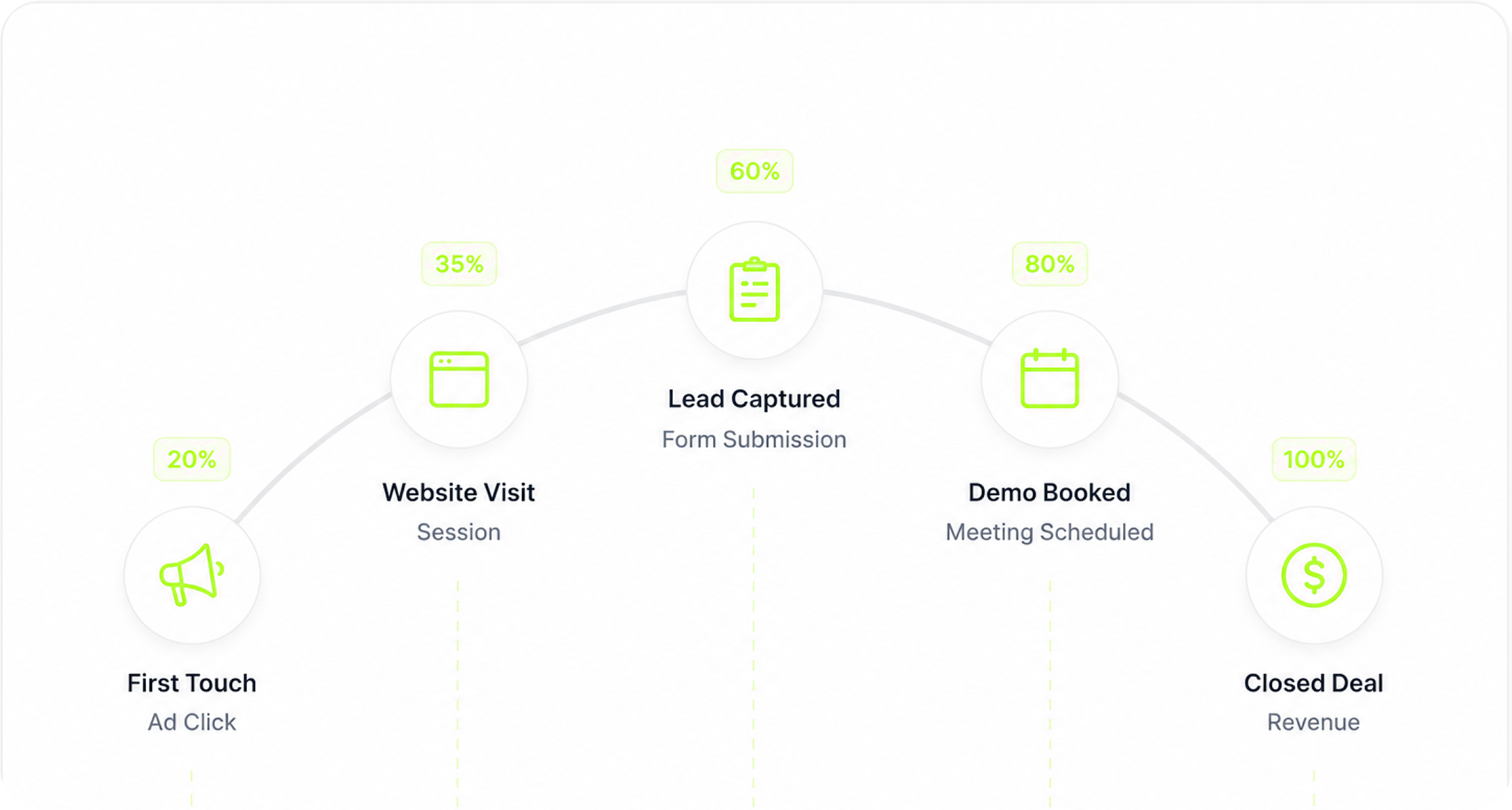
See what actually drives revenue
Follow every customer journey from first touch to conversion — see which channels and campaigns actually drive revenue, not just clicks.
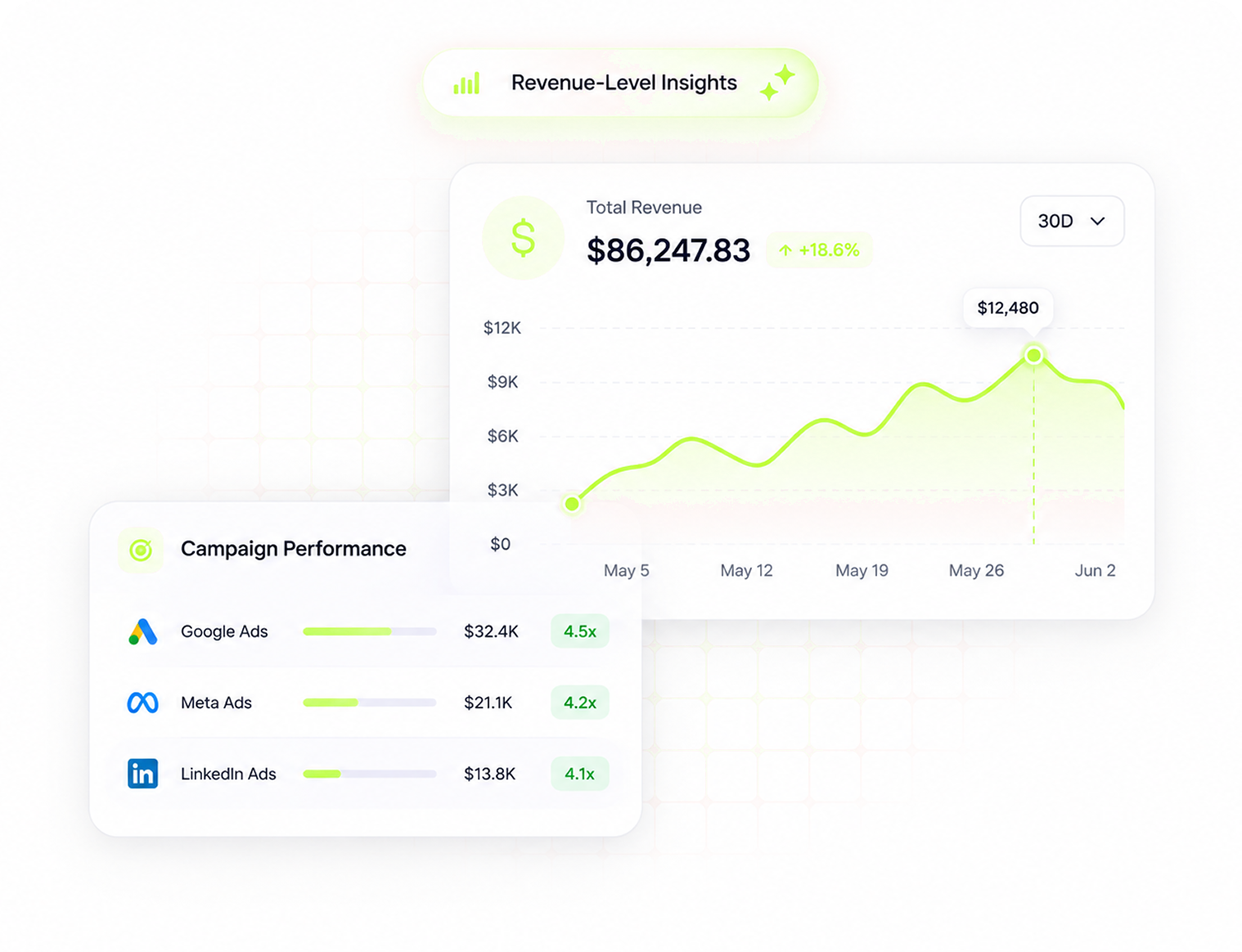
Revenue-Level Insights
Go beyond leads. See which campaigns drive revenue and maximize your return.
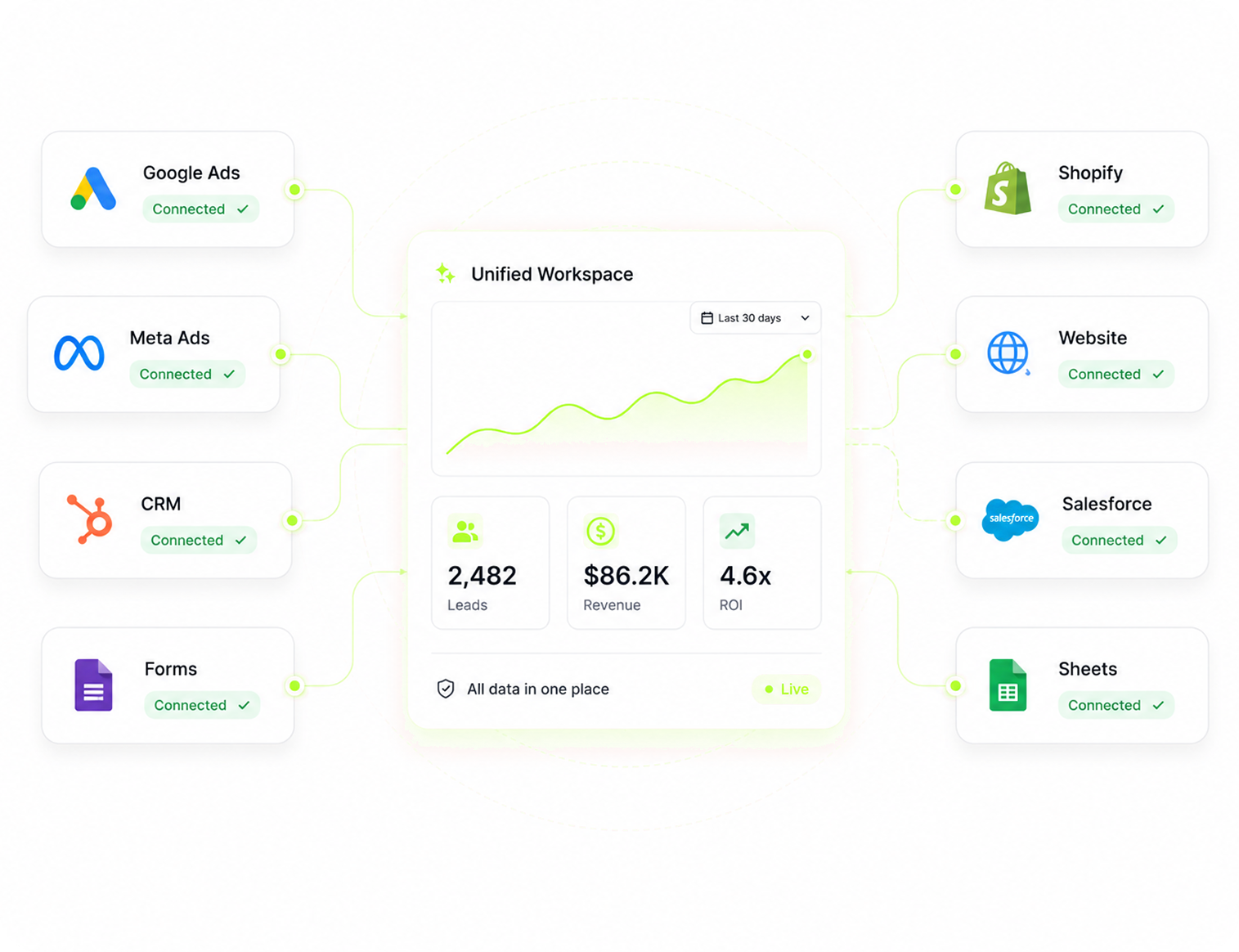
Bring your marketing data together
Connect forms, CRM, ads, and customer data in one place. Get one clear view of performance.
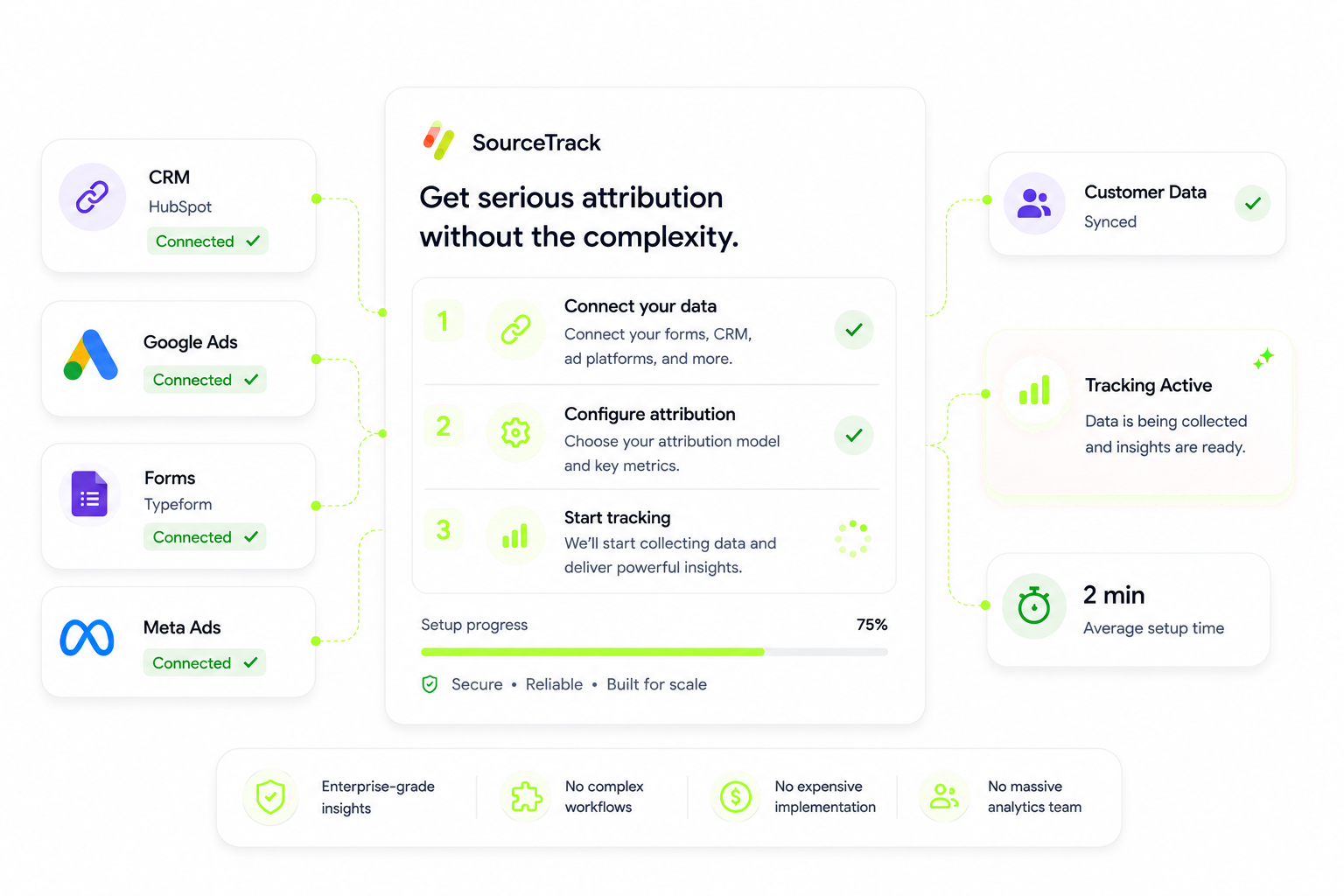
Enterprise Power Simple Setup
Set up SourceTrack in minutes. Get enterprise-grade insights without complex workflows or costly implementation.
Pricing
Everything you need to connect marketing activity to revenue
with plans built for teams at every stage.
Track marketing performance with essential attribution and revenue insights.
 250K tracked pageviews / monthMulti-touch attributionAI & search detectionPrivacy-first trackingEmail & chat support
Go deeper into attribution. Connect revenue sources and see what drives growth.
1M tracked pageviews / monthSEO revenue attributionStripe & Shopify integrationsCustomer journey insightsAdvanced attribution analyticsFAQ
Clear answers to the questions teams ask before getting started with attribution.

No. Keep your existing analytics setup. SourceTrack works alongside it to connect marketing activity with revenue.
No. SourceTrack captures native, same-origin form submits out of the box — Webflow, WordPress, and custom HTML forms — no form edits required. Embeds that load in a cross-origin iframe, like Tally and some HubSpot and Typeform setups, aren't reachable by page scripts and need their own native webhook instead.
Yes. SourceTrack stitches touchpoints across organic search, AI referrals, and direct visits even when no UTM is present.
Yes. SourceTrack detects 16 AI referral tools (ChatGPT, Claude, Gemini, Perplexity, etc.) and attributes downstream conversions back to the AI session.
Five minutes. Drop one script tag in your <head> or install via Google Tag Manager — no engineer required.
Yes. The standard tracker keeps a random, site-specific visitor ID in your own domain’s localStorage: no third-party cookies, no cross-site tracking, no canvas or font probing, visitor identifiers never shared between different companies’ websites, DNT and GPC honoured. Cookieless Mode, a setting on paid plans, uses no cookies and derives the ID on our server instead.
The Sourcetrack difference
See what your CRM misses. Connect every touchpoint to know where leads came from and what drove revenue.
Amar Osei
amara@nortwind.example
Journey
Before SourceTrack

Amar Osei
amara@nortwind.example
$2,480 — AI Search
Journey · 6 Touchpoints over 19 days



With SourceTrack
Connect every touchpoint, see which channels drive revenue and make smarter marketing decisions with SourceTrack.